Guy goes into a Hi-Fi shop and buys
himself an average stereo system, nice pair of speakers and an amp that puts out a hundred watts
RMS on each channel. It sets him back a fair few drinking vouchers and he's quite proud of it
so he goes over to his brother's place to brag about it. His brother has also been down the town
and got himself a new 5+1 system that puts out a measly ten watts RMS per channel, plus a fifty
watt bass bin/amp, which he has hooked up to his old cheap CD player. It has really silly tiny
speakers and they are hidden round the front room but at a mere couple of degrees up on the volume
control, it sounds ridiculously loud and amazingly clear,.. first brother is actually a bit
less than impressed by the fact that this cheap pile of plastic junk sounds so good.
There is a point to this,... I run a PA system that is less powerful than most rigs
but I still get enough level to fill a decent sized venue, even open-air gigs. When I say it
puts out just over 2K, I sometimes get odd comments from other sound techs,.. most of them not
really printable here. I also get a fair few comments on how clear the sound is,... from punters
who know nothing about the size or power of the rig (probably don't care either) and the
reason is not the number of watts it puts out but the design and type of speakers I use.
Over the past few years, gig sound engineering has fallen prey to the "boy-racer" syndrome
in that every upgrade of a rig gets more power added and most rock PA rigs now pack a hefty
5K plus. Five THOUSAND watts of power?? Why? For those of you who have gone out an' blown megga
wads of hard cash, or hocked yourselves to the banks for such massive power,... stop reading here
cos I'm really gonna get up your nose! Raw power is not and never has been the answer for good
sound systems. There is a stupid myth going on in the PA world and if you have been really proud of your
1,000 watt drivers,.. you really should have listened to your physics teacher in school, there
are some very basic laws that make such speakers a pretty awful waste of money!
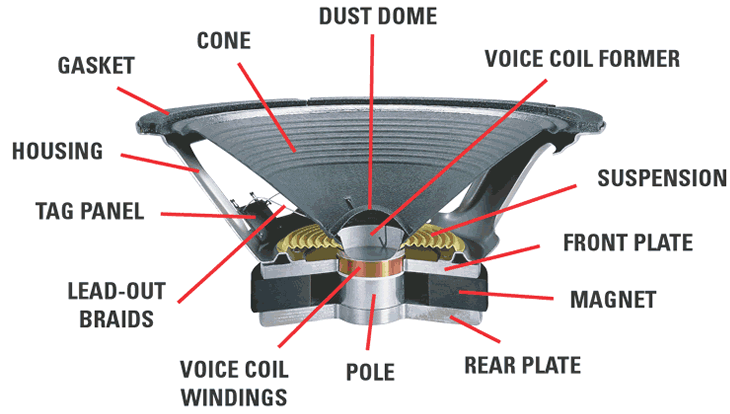
I don't suggest you try cutting up your loudspeakers to see how they work,
so I have got this pic from Celestion's
pages, (well worth a visit) so you can see what's going on inside without an angle grinder!
Still here? OK,.. a loudspeaker coil is made up of fairly thin copper wire, if you pump
lots of volts into it, three things happen,..
1, Because it's a coil of wire, it generates a magnetic field of it's own, the polarity
depending on which end of the coil is positive.
2, Because it is sitting in a magnet already with a fixed polarity, it moves. and the
speaker cone moves with it making the air vibrate and hence it makes noise.
3, Because the wire is thin, the more volts you put into it, the more current will flow
and it will get hotter. If you push the volts up too high,.. it will get so hot the copper will
burn out and all sound will cease. This usually happens during the most amazing guitar solo
with devastating silence following a brief unintentional crunchy sort of noise with,...
"'ot th' 'uc' w' 'at?" from the vocalist
You might also notice that when you switch on a light bulb that puts out very few watts
by comparison, it gets really hot. Exactly the same thing happens to your loudspeaker coil,
it also gets hot. Ah,... when you heat up a magnet, it's magnetic power falls off quite sharply
so that means as your poor little coil heats up it gets less effective. Not only that,.. if you
heat up any conductor of electricity, it's resistance goes up. At this point we are out of
accoustics (fluid mechanics) and into thermodynamics and the relationship between thermodynamics
and fluids throws up a whole rack of interesting maths and technobabble that will bore the pants
off you so I'll try to keep it simple.
As your speaker gets hotter, its power handling becomes less to do with sound and more to
do with survival. As it gets hotter, its tone quality will alter because the resistance of the
coil is changing relative to its now varying inductance and that gives you a rather random tone
shift. This means that the money you blew on graphics and a spectrum analyzer is irrelevant now!
As it gets hotter, the cone will not move as far for a given input because the magnet
is not as effective and less current is flowing anyway. There is a sort of balance point and
it starts to come in at around 250 to 300 watts. Over that level, coil survival becomes more
important than sound level output (SPL) in the design. Then there is that thermodynamics thingy
that also gets into the air round the speaker. As the air heats up, the way it transfers the
vibrations of sound alters as it changes density, the density of the air changes quite fast
with distance from the coil and thus with changes in air temperature, the resonant frequency
can also change. If the air is getting hot it tends to try and travel upwards (convection) and
for the speaker cone trying to vibrate it, it's a bit like trying to handle a wet bar of soap
underwater in a jacuzzi.
If you want to hear my honest opinion on the sales blurb for these high-power drivers,...
click HERE

Interesting point to note here is that you will see the power handling of a loudspeaker
in the specs,.. but the sensitivity is the one you SHOULD look at because that is the one that
tells you how loud the thing really is. Funny thing here is the level they test that bit at,..
1 Watt at 1 Metre, and this gives rise to some very enlightening comparisons. the smallest
change in level the human ear can detect is 1dB and when something is "twice as loud" it is
only 3dB up on the other level. So here I will show you the characteristics of three speakers
you can go out and buy "off the shelf" all are 12 inch drivers.
Speaker A,
Sensitivity: 99dB @ 1 watt @ 1 metre
Power handling: 150 watts
150 watts = 21.8dB above 1 watt
Max output: 99dB + 21.8dB = 120.8dB @ 1 metre
Speaker B,
Sensitivity: 98dB @ 1 watt @ 1 metre
Power handling: 300 watts
300 watts = 24.8 dB above 1 watt
Max output: 98dB + 24.8dB = 122.8dB @ 1 metre
Speaker C,
Sensitivity: 90dB @ 1 watt @ 1 metre
Power handling: 1000 watts
1000 watts = 30dB above 1 watt
Max output: 90dB + 30dB = 120dB @ 1 metre
(this measurement applies in an ideal world,...
in other words it's theoretical and in reality is not quite there!!)
So if you look at those specs, you will see that a very popular 1,000 watt driver is in
fact not as loud as it's cracked up to be,.. quieter even than the cheapie 150 watter albeit
at a mere dB-ifference only dogs or bats could appreciate, particularly at those levels!
If you add to these specs good cabinet design and by that I mean efficient cabs for the drivers,
not just a tarty looking box,.. you will have enough sound level to get praise from the audience
and complaints from "neighbours" half a mile away and save yourself a small fortune too! Bear
in mind the fact that with that 300 watt driver flat-out, you are actually into the levels of
sound that really do damage ears and it's over the threshold of audio pain,..
Oh you just bought the big *** bins,.... oh well, never mind!
There's now page dedicated to speaker cabs and bins that is getting long over-due attention
HERE.
I also use a slightly different way to get the sound around a venue,.. I use back-fills,
by that I mean having a couple of speakers at the back of the place as well as the main stacks.
This gives a better overall cover of sound with far less mechanical effort. (Less watts) It also
means that feed-back is not going to be a problem and the graphic doesn't need a couple of octaves
of vocals dropped into the mud to get round the screaming banshees in bigger systems.
Animated gifs on this page from HERE