In spite of all the high technology available these days, in the form of computer based audio
systems; there are still those boring old gits who insist that a glass tube with a strange
collection of bits of metal inside, and all the air sucked out, still makes a better sound
than the latest transistor amplifiers.
Of course anyone who has "studied" electronics knows that these old valve circuits have not
even a hope of getting the "signal-to-noise ratio" that state of the art kit can achieve.
That is of course quite true but to be honest, that also is a bit misleading as I don't know
of a single course syllabus that actually covers valve circuits and very few tutors even mention
them in passing!
So why is it that guitarists will pay double the price for a monster tower of amps and cabs with valves?
Why would a top studio want a valve microphone pre-amp or compressor to feed that really expensive mic into and not just
the latest super microprocessor controlled digital jobby?
Does the "warm sound" have anything to do with the fact that these fragile glass components
will take your skin off if you handle them and can chuck out more Watts in heat than sound level?
This is the music business here mate,... nothing is supposed to make sense is it? How can we
get a "pure" note out of such old noisy kit? Well that depends on what you call pure I guess.
It's all very well sitting down with a digital editing suite and cleaning up the wavs till
they have notes, pure notes and nothing but the notes,.... but have you really improved the sound
by doing so, or have you lost something? Theoretical audio is always evolving but the human ear
is still the same bit of skin and gristle it always was, so can we really teach such an old
bit of kit new tricks?
No,.. and to make matters worse, the human ear is not nearly a linear
device as far as audio pick-ups go and added to that, it is connected to a very individual
filter called the human brain and any guy who has met more than one woman will tell you the
brain is not a stable filter at all!
(Actually, that comment cuts both ways doesn't it ladies?!)
It is possible to fool the ear and the brain into where a sound is coming from in space, but
most ears will be able to tell the difference between live and studio recordings, depending
on how many rock concerts they've been subjected to! The ear is an amazing device all on its own
but when you consider the added selective effect that the brain adds to what it "hears", then
no other system of audio pick-up can even approach its quality, or its eccentricities.
I still have my collection of vinyl records and no matter how pristine the new CD might be, there is something
about the hiss, crackle and other spurious noises that make them special to me. It really has
nothing to do with sound "quality" in the theoretical sense. It has far more to do with the fact that
when I first listened to these classics like "Stairway to Heaven", it was on a really cheap
and nasty mono BUSH record player cos that's all I could afford thus, the hiss crackle and
distortion became a part of the audio experience. Perfect it wasn't but it was, at a mere twelve
watts, loud enough to upset the neighbours,.... frequently! More to the point, it was the music
I was listening to, not the sound quality. Yes I do have amps now that are silent till driven,
put your head in the bins and the first note will make your nose bleed! I also have some really
nice digital instruments but there is something about a sound that is less than clinical,..
it is closer to what I hear in the real world. That is where old valve technology scores so
heavily, it does distort but when it does so, it actually produces harmonics that are related to
the musical scales we play, or listen to so it tends to add something that fits rather than
sticking out like a sore thumb.
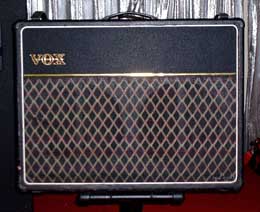
This is the reason that an old VOX AC30 can sound louder than some modern 100 watt amps, it's that the
overdriven valve produces a unique addition to the sound of a guitar that is very hard to accurately
"emulate" with any solid state device. The sound Brian May gets out of a wall of these antiques
is ample testament to that, quite apart from his own unique talent for making one note do more
than most guitarists do with several!
The HAMMOND sound was born in valve state entirely, the little click that accentuated the notes
was a function of the high voltages and not a designed in effect. Again, the classic "Whiter Shade
of Pale" was done with a Hammond M100 series and nothing quite gets the same feeling, because
it also had the same characteristic sound as the amp heads the rest of the band were using.
The overall mix was thus producing the same "tuneful" harmonics, giving a wall of noise that was
acceptable to the musical ear.
Two other more technical quirks to add to this is to do with the actual voltages that these two
technologies operate at. Solid state pre-amp devices have power supply rails that are quite low, anything
from 3 to maybe 30 volts. These voltages are very flat and regulated. If you drive a signal till
it manages to reach the supply rail, the top of the signal gets very flat with very sharp edges (square waves).
This has the effect of severe distortion and masses of harmonics, overdriving digital recorders
shows this up real quick!
Valve circuits on the other hand have voltages that are above 100 volts and the smoothing is not
as acute. The point at which a signal "hits" the anode voltage is softened by the resistor
feeding it and that resistor, with the smoothing capacitor, creates a low frequency "time-constant" which tends
to round off the edge of the resulting 'distorted' signal, thus the imperfection
is not so jagged on the ear. HH in the UK, made a module for their solid-state amps that consisted of a series
of such filters to get close to a valve sound. Rocket science it ain't but it was close, not close
enough to put
Jim Marshall out of business though! HH is gone, Jim is still very much in business,.. kinda says a lot.
Ah yes,.. I mentioned heat in passing didn't I? Interesting thing about noise from solid state
stuff is that the figures they give you only apply to "bench" conditions usually, which means as
soon as the thing gets hot in the rack you crammed it into, the noise gets worse because most
components get noisy when hot. Solid state will die around 50 degrees C, unless it's military spec
and you won't find much music kit built with such high spec., expensive devices, if any. Valves on
the other hand, are designed to work hot, hence getting a bit warm in the rack aint gonna make the
slightest difference is it?
I remember a rack of HI-WATT PA amps that were all valves, you could (and we did)
fry breakfast on the top of them! Heat will not kill your valve amp, it will still be just the same as when it
quit QA,.. unless you fiddled with it! A hot stage can and frequently does literally send solid-state gear up in smoke.
And one final point,... stupid I know but if the worst was to happen and some idiot actually
did "push the button" to wipe out the world as we know it,... all your super-conductors and
high-tech semiconductors will be dead with the first bang. Valves (and beetles apparently) will survive, so at least
rock music will live on,... even if we don't?
Coming up next,....
WHAT DOES A PICKUP PICKUP?
WHAT MAKES AN OLD ORGAN COME TO LIFE?
ECHO,..ECHO,...echo,.......echo,...
NEW LIVES FOR OLD LESLIES!
If you are into building stuff from scratch, try ESP!!

This site is really useful,..
....the circuits seem to work too! (I've tried a couple myself)